To obtain a driver’s license, learner drivers must pass two tests – a practical and a theoretical one. The practical driving test ,Theory lessons at a driving school are designed to prepare students for the latter. Depending on the license category, a specific number of mandatory lessons must be completed. The theoretical exam then takes place at TÜV or DEKRA.
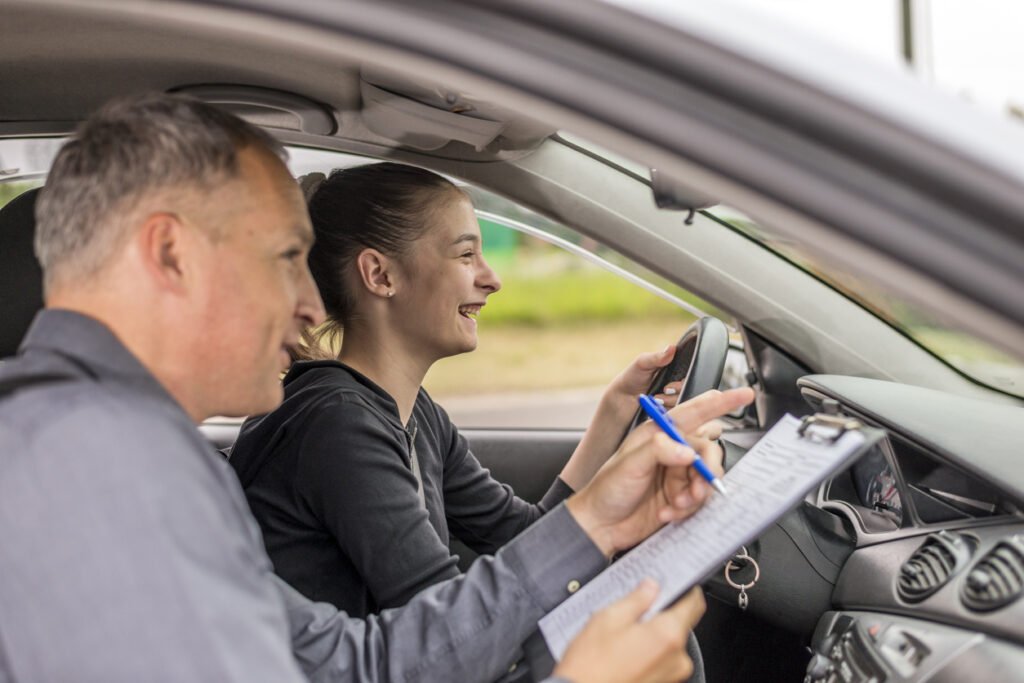
Once the theory test is passed and all required special driving lessons have been completed, a learner driver is admitted to the practical driving test and can take it promptly. During the test, a driving examiner , along with the driving instructor, sits in the car and checks whether the student adheres to the rules of the road.
The duration of a practical driving test depends on the driving license category. A practical driving test follows a procedure stipulated by the examination regulations . This guide explains what this procedure entails, the costs associated with a driving test, and what happens if you fail.
FAQ: Practical driving test
When can I register for the practical driving test?
You can register once you have completed the mandatory driving lessons and passed the theory test .
What tasks can be set during the practical driving test?
You can read here about the tasks you can expect during the respective driving tests for each driving licence category .
How many times can I retake the practical driving test?
There is no limit; you can attempt as many times as you like. After failing a test, you should work with your driving instructor on your weaknesses and only attempt again when you feel confident.
Further information about the practical driving test
- Safety check during the driving test: Start well preparedBecoming a driver’s license holder is exciting enough. Not only do you have to drive safely and legally through traffic, but you also have to assess the vehicle’s technical condition. To test this ability, the driving test includes a safety check. Read on to find out how to master it. » Read more…
Procedure for the driving test
The procedure for the driving test depends on the driving license category being sought. Depending on the category, different tasks are presented to the test candidate. These tasks are specified in the Driving Licence Regulations ( FeV ). In principle, the following applies to every test drive according to Annex 7 to Section 16 Paragraph 2, Section 17 Paragraphs 2 and 3 :
The applicant must be able to drive the vehicle independently, safely, and in accordance with traffic regulations, even in challenging traffic situations. Their driving style should be defensive, considerate, anticipatory, and adapted to the flow of traffic. Furthermore, they must demonstrate sufficient knowledge of the legal regulations governing the operation of a motor vehicle, as well as an understanding of environmentally conscious and energy-efficient driving style, and be familiar with the dangers of road traffic and the necessary behaviors to mitigate them. Particular attention should be paid to correct behavior, handling, and execution in the following areas:
- Driving technique preparation,
- Steering wheel grip
- Behavior when starting off,
- Gear change,
- Inclines and declines,
- automatic power transmission
- Traffic observation and adherence to traffic signs and devices,
- Driving speed,
- Keep your distance from the vehicle in front,
- Overtaking and passing,
- Behavior at intersections and junctions, roundabouts and level crossings,
- Turning and changing lanes,
- Behavior towards pedestrians and at tram and bus stops,
- Driving outside built-up areas and
- Technical conclusion of the journey.
Tasks during the practical driving test
Furthermore, specific tasks are set for each driving licence category. These are also stipulated in the Driving Licence Regulations (FeV). They consist of a certain number of basic driving maneuvers from which the examiner can choose. The following is a list of the tasks that the test candidate can expect:
- Four basic driving maneuvers for class AM : slalom, braking with maximum possible deceleration, swerving without braking, swerving after braking, driving straight ahead at walking speed , stop and go or driving in a circle.
- Six basic driving maneuvers for classes A, A1 and A2 : slalom at walking speed, braking with maximum possible deceleration, swerving without braking, swerving after braking, slalom or long slalom, driving straight ahead at walking speed, stop and go or driving in a circle.
- Three basic driving tasks for class B : Driving backwards to the right using a junction, intersection or driveway, reversing into a parking space (longitudinal parking), braking with maximum possible deceleration, entering a parking space (perpendicular or angled parking) or turning around.
- A basic driving task for classes BE, DE and D1E : reversing around a corner to the left.
- Two basic driving tasks for classes C, C1, D and D1 : reversing and maneuvering to the right up to a ramp for loading or unloading (only classes C, C1), stopping to get in or out (only classes D, D1), reversing to the right using a junction, intersection or driveway, reversing into a parking space (parallel parking) or reversing into a parking space perpendicular or diagonally .
- A basic driving task for class T : reversing straight ahead.
These are the tasks you should expect during the test. The failure rate for a driving test in Germany is around 25 percent . If you fail the practical driving test, you can retake it on a different date. Retaking the driving test incurs additional costs.
If you pass the driving test , you will subsequently be issued your
driving licence as proof of your driving licence .
Practical driving test – these tips will help you
The practical driving test is a particularly stressful situation for the test taker . There’s no universal remedy for the anxiety surrounding it; a little nervousness is always part of the experience. These tips should help you overcome your anxiety for the practical test :
- Before the test : You should be well-rested for the practical driving test. Therefore, go to bed early the night before. Make sure you arrive on time for your scheduled test appointment. Once your driving instructor has introduced you to the examiner, get into the vehicle and the practical driving test can begin.
- Before departure : Once you are seated, first adjust your seat position. Then adjust the steering wheel and the exterior and rearview mirrors. Important: Don’t forget to fasten your seatbelt! After these adjustments have been made, the examiner will explain the procedure to you. This will include specifying which commands you can expect.
- During the practical driving test : The examiner will usually give you instructions on which direction to drive and when to demonstrate your parking skills. If you don’t understand an instruction, don’t hesitate to ask again. The examiner will then repeat it. Remind yourself of the skills you learned in driving school for the test and try to remain calm. Most of the nervousness will subside after five minutes, and you can then fully concentrate on the practical driving test.
Practical driving test – tips in brief
- Always check your mirrors while driving! It’s important that you also turn your head towards the mirror, otherwise the examiner won’t be able to see your gaze.
- Don’t forget to check your shoulder!
- Always check your speed !
- Pay attention to the traffic signs! If necessary, you must follow the signs if the examiner gives no instructions.
- Don’t let tailgaters or aggressive drivers unsettle you!
- Approach intersections slowly!
- Pay attention to other road users! Especially cyclists and pedestrians.
- Listen carefully to what the examiner asks of you! Key point: parking or stopping.
- Focus on your abilities! If your driving instructor gives the “go-ahead” for the test, he is convinced of your skills.
Driving test – the duration for the individual driving licence categories
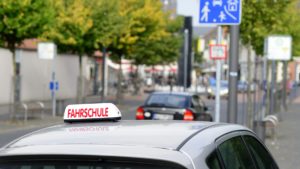
“How long does a driving test take?” – the answer to this question depends on which driving license category you are applying for. The following lists the duration of each test drive for the different categories:
- Driving licence category AM : 30 minutes
- Driving licence category A1 : 45 minutes
- Driving licence categories A2/A : 60 minutes
- Driving licence category B : 45 minutes
- Driving licence category BE : 45 minutes
- Driving licence category C : 75 minutes
- Driving licence categories CE/C1/C1E : 75 minutes
- Driving licence category D : 75 minutes
- Driving licence category DE : 70 minutes
- Driving licence category D1E : 70 minutes
- Driving licence category T : 60 minutes
Driving tests are usually simulated beforehand at the driving school . During this simulation, the driving instructor can give you important tips for the actual test. The test time can, of course, be extended if, for example, you get stuck in traffic. Therefore, a practical driving test will never last exactly 30 minutes . It’s only a guideline.
Failed the driving test
If you fail your driving test , you can retake it at a later date. To do so, you will need to schedule a new appointment and may need to take some driving lessons beforehand to correct your mistakes. On average, about a quarter of test takers fail the practical exam each year .
Don’t let this discourage you. Blaming the “evil” examiner after the fact won’t get you anywhere either. Prepare even better for your next attempt and pay particular attention to the mistakes you made in the first exam.Once the driving licence has been obtained through the practical test, it can be
used immediately .
Practical driving test – these are the costs you will incur
If a practical driving test is required for your license, you must pay a fee to the relevant testing authority. The fees vary depending on the license category . For category B , you pay a registration fee of €91.75 to TÜV for the driving test.
If you fail , you must pay the same amount again for the retake. The fee for the driving test must also be paid again at the driving school .
Practical driving test – these are the questions you can expect from the examiner. The driving examiner will ask you some questions before or during the test. However, you don’t need to be afraid of them! He will simply ask you to switch on a specific light or, if necessary, to check the tread depth of your tires.
Driving licence test class B at 17
Since January 1, 2011, it has been possible in Germany to apply for supervised driving at the age of 17. This allows drivers to bypass the minimum age of 18 for obtaining a driver’s license. However, this regulation is subject to a condition – the learner driver may only drive a motor vehicle when accompanied by a previously designated person.
There is no limit to the number of accompanying persons , but they must be specified in advance and cannot be added later. These persons must meet the following requirements :
- A minimum age of 30 years
- At least five years in possession of a valid driver’s license
- No more than one point on the driver fitness register in Flensburg
The accompanying person’s duties include providing the learner driver with reassurance and answering any questions that may arise. It doesn’t matter where the person sits in the car; the important thing is that they are present.
A pink document is issued as a certificate of completion for the driving test at age 17. This serves as your driving license until you turn 18. On your 18th birthday, you will then receive your actual driving license by mail.Attention: The temporary driving licence is
only valid in Germany! It is not recognized abroad.
Changes to the practical driving test 2021
At the beginning of 2021, some changes regarding the practical driving test came into effect. The test drive was extended by ten minutes .
During the practical driving test, the candidate must complete eight driving tasks and demonstrate their competence in five areas . A five-minute feedback session will then follow.